
56 DAYS IN OFFICE: FAYEMI FACES MAJOR LABOUR CHALLENGE
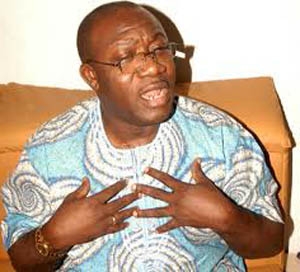 Governor Kayode Fayemi of Ekiti State seems to have started his administration on the right foot, but his success will largely be determined by the way he handles the raging minimum wage issue in the state
The declaration of Dr. Kayode Fayemi as the governor of Ekiti State on October 15, 2010 by the Court of Appeal was greeted with jubilation by residents and lovers of the state. The governor, who was inaugurated the following day, made some promises at the ceremony which was attended by an unprecedented crowd.
Fifty-six days after the change of government in the state, most people are now saying that the umbrella of the Peoples Democratic Party, which was foisted on them and was later blown off by the judiciary, had shielded them from enjoying good governance.
One of the pronouncements of Fayemi, which had triggered jubilation across the state, was the slashing of the fees charged in all the state-owned tertiary institutions. Fayemi, who promised to review the fees on the day of his inauguration, had pegged the highest fee in the institutions at N50,000 from the over N200,000 approved by the Segun Oni-led administration. Students in the state had engaged Oni in a fierce battle over the fees, but Oni remained adamant. The students, who said that the exorbitant fees had forced many of their colleagues to drop out of school on August 23, had stoned Oni, who went to the University of Ado Ekiti to attend the school’s maiden university lecture. The ousted governor had to be smuggled out of the campus under a heavy security cover as the students were bent on hurting him.
But the reduction in school fees announced by Fayemi brought joy to the students, as well as their parents, who said they had started to reap the fruits of their labour with the inauguration of Fayemi as their governor. The president of the Students’ Union Government in UNAD, Mr. Kehinde Usman, lauded the government for the reduction.
But Fayemi’s dissolution of the 16 local government councils in the state had triggered criticisms. The governor, following the dissolution, constituted caretaker committees for the councils. But the sacked local government chairmen, who were all members of the PDP, refused to vacate their offices. They resumed on November 18 and this led to a clash as a mob descended on the sacked LG bosses and chased them out of their various secretariats before the caretaker committee chairmen and members could resume. The sacked LG bosses later went to court and the case is still pending, while those appointed by Fayemi have started running the affairs of the councils.
The new government, in earnest, started the rehabilitation of roads in the state. Fayemi had said that in spite of the fact that Oni’s administration left a huge debt from road contracts, many of the projects were either abandoned or were substandard. Many roads, especially those in Ado-Ekiti, the state capital, had become death traps before the court sacked Oni. But the speedy rehabilitation embarked upon by Fayemi’s government has made driving smoother in the state.
The people of the state were shocked when the auditors and accountants in the civil service made public the debt profile of the state. The debt, which was put at N40bn, was described as outrageous, especially in a state with a monthly allocation of N2.5bn. Based on this revelation, Fayemi, who assured the people that his administration would make an attempt to reduce the debt, said that he had begun negotiations with some banks the state was indebted to in order to reduce their interest rates.
To ensure that the state was not made to pay for the services not rendered to it, the governor had set up a committee to review the contracts awarded during Oni’s tenure. A major term of reference of the committee is to determine whether the mobilisation/payment made was commensurate with the work done so far.
Fayemi, who had earlier met with the contractors handling road projects awarded by Oni, assured that he would not terminate any contract just because he was not the one who initiated them, but would ensure that the people of the state enjoyed whatever the state was made to pay for.
Fayemi had explained that the review of the contracts/consultancy was not a probe as his administration did not want to lose focus on its agenda to impact positively on the lives of the people.
He had said, “I want to seize this opportunity to disabuse the minds of our detractors that this committee is designed to malign the last administration. It is not the intention of this administration to probe the immediate past government. Rather, we are taking steps to ensure accountability.
“This is not a probe of the past administration because that is not our focus, but to ensure accountability and fairness in the award of contracts, so that this government will not deviate from its plan to commit itself to the rule of law and maintain transparency at all times.”
An incessant problem in the health sector, the new salary scale crisis, was immediately tackled by the new governor. Based on this, the Medical and Dental Consultants Association of Nigeria at the University Teaching Hospital, Ado-Ekiti had lauded the new administration for approving the new salary scale for medical workers. The chairman of MDCAN, Dr. Obitade Obimakinde, said that the new salary scale would boost the morale of workers and make them to be more committed to their duties.
However, Fayemi nearly had a clash with the workers when he announced in a subtle way that the state might not be able to pay the N18,000 minimum wage because of the lack of resources to foot the bill. However, the governor admitted that the new minimum wage was grossly inadequate for any worker to spend in a month. He said that it was unfortunate that some states, including Ekiti, might not be able to pay it. He explained that the state, with a population of 2.3million people, got N2.5bn as its monthly allocation and spent N1.7bn on the wages of its 40,000 workforce.
The governor had said, “One of the challenges we are facing is that the resources are not available to cater for the need of workers and when they are available, they are lopsided. It is not that the figure ( N18,000) is too much, it is just about affordability based on the resources available to the states. What happened the other day would have amounted to a federal minimum wage, which really does not apply at the state level. There are states that can pay more than N18,000 as minimum wage, while there are some that can pay up to N40,000. It is not too much. There are states that would also go bankrupt; that won’t be able to send children to school; make free health available or construct roads.”
The governor’s comment on the new minimum wage was greeted with criticisms from the workers. The chairman of the Nigeria Labour Council in the state, Mr. Joseph Arogundade, said that workers in the state would not take anything less than the amount.
The NLC boss described as unacceptable Fayemi’s explanation that resources available to the state were too meagre. Arogundade said, “We are asking for what is commensurate with the service we render. We are not asking the state government for a favour, but to pay us what is reasonable. There is a need for the government to pay us what is commensurate to workers’ services. We want to call on the governor of Ekiti State, who is also an activist, whom all workers of Ekiti State love, to look for money by whatever means possible so that as soon as the new minimum wage is approved he will ensure payment.”
Reacting to the workers’ comment, Fayemi said that he was aware that Nigerian workers deserved more than the N18,000 minimum wage. He said that he would discuss the way out with workers and other stakeholders in the state.
He said, “We also want to emphasise that this administration shall never be on a war path with the workers and their unions and we have no reason to do so. This state enjoys industrial peace and harmony, which we want to preserve for the benefit of all and sundry. This administration enjoys the best of relationship with its workforce, which it holds in high esteem and will do everything possible to enhance its welfare as a motivation to work harder towards the development of the state.
“We appreciate the support of the workers throughout the three-and-a-half years’ struggle to reclaim the popular mandate of Ekiti people to have this government enthroned and everything possible will be done to sustain the massive goodwill it presently enjoys.”
On how to ease the problem of transportation in the state, Fayemi has assured that his government will provide an alternative to commercial motorcycle transportation. He made this known during a courtesy visit to him by a delegation of the Union Bank led by its Executive Director, Commercial in the South-West, Mr. Kunle Adeosun. He said that his administration intended to phase out commercial motorcycles in Ado-Ekiti, but assured that the government would import mini buses and cars to serve as an alternative to motorcycle transportation. According to him, such vehicles will be sold to okada riders at affordable prices.
Although today marks the 56th day of the administration of Fayemi, the people of the state have started nursing the hope that a completely different and better democratic environment will soon be enjoyed by all. It is, however, instructive that the way Fayemi eventually solves the workers’ minimum wage palaver may ultimately determine the aggregate success of his government in the eyes of the people.
—————